A single plumber in Leeds does not need a website that talks to the whole country. He needs one that talks to Leeds. That simple idea, narrow the geography, sharpen the message, and let the phone ring, is the entire engine behind how Local Call UK’s trade-and-city website model works, and it explains why hundreds of small trade businesses across Britain now rely on it instead of building one sprawling national site.
This article breaks down the mechanics behind the model: how the sites are structured, why the combination of trade and city works so well for search visibility and call volume, and what business owners should weigh before adopting the approach.
Key Takeaways
- The model pairs a specific trade (plumber, electrician, roofer) with a specific city or town to create a tightly focused website rather than one broad national brand.
- Each micro-site is built around local search intent, meaning pages target phrases real customers type when they need urgent, local help.
- Call tracking and simple contact paths sit at the centre of the design, since the goal is a phone call or enquiry, not just page views.
- The structure scales by template, allowing new trade-and-city combinations to launch quickly without rebuilding the system from scratch.
- Success depends on genuine local relevance, thin, duplicated pages without real local detail tend to underperform.
What Is Local Call UK’s Trade-and-City Website Model
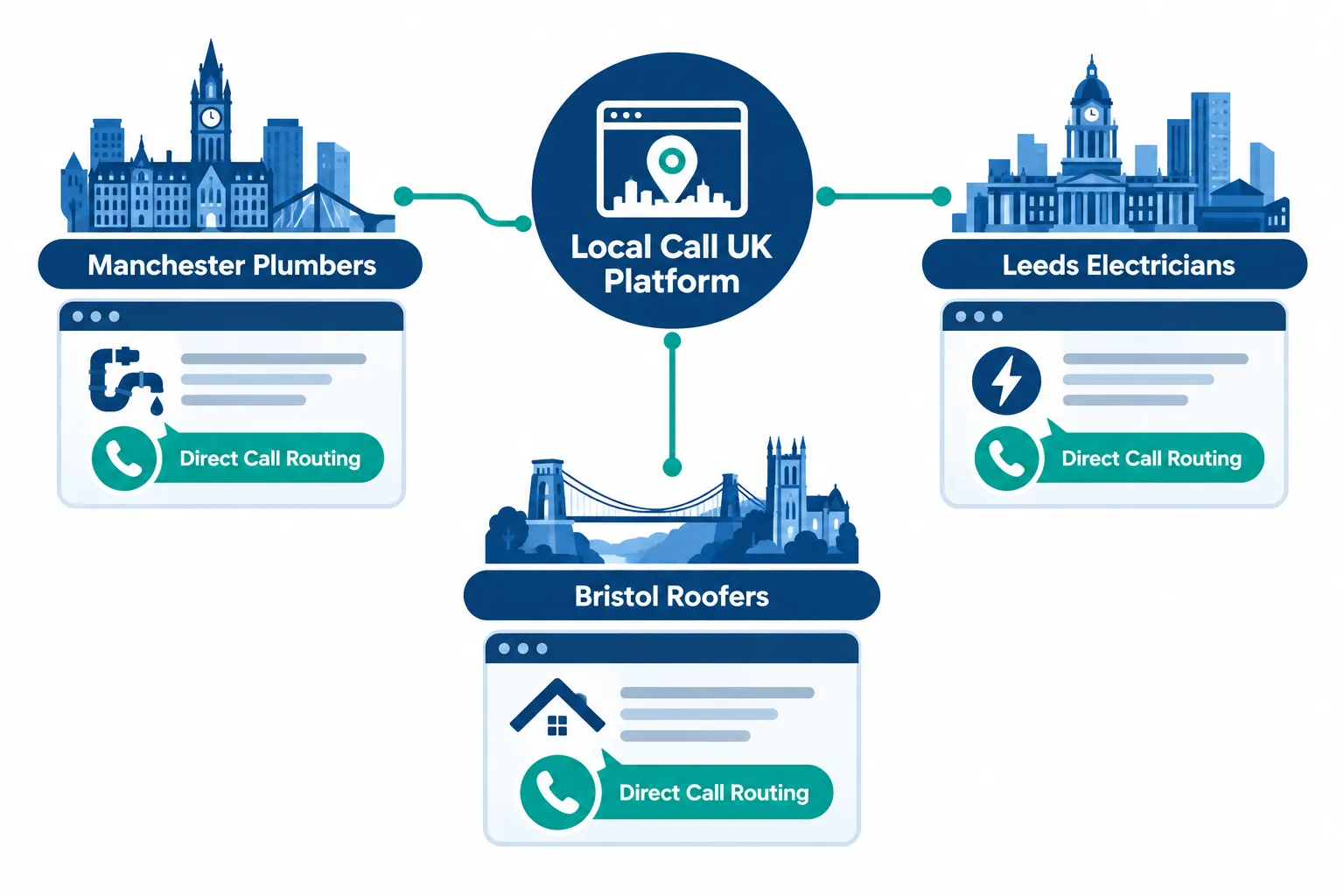
At its core, the model treats “trade” and “city” as two variables that combine to form a single, focused website. Instead of one large site trying to rank for “electrician UK,” the approach creates a dedicated presence for “electrician in Sheffield,” another for “electrician in Coventry,” and so on. Each site is narrow in scope but deep in local relevance.
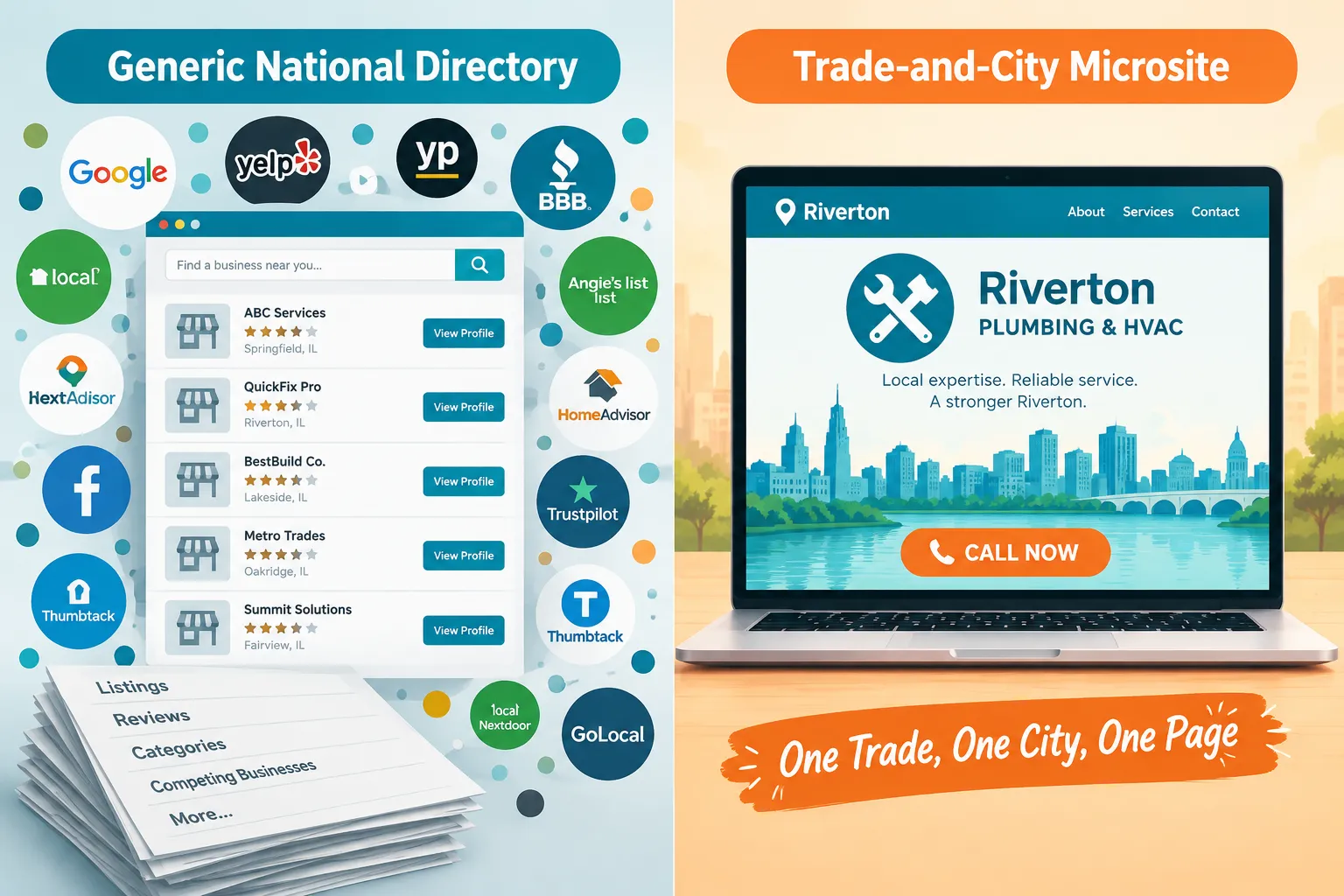
This differs sharply from the traditional national trade directory, where hundreds of businesses are listed on one domain and customers must search, filter, and compare. The trade-and-city model instead puts a single, clear offer in front of a local searcher: one trade, one location, one phone number to call.
The logic mirrors how people actually search when something breaks. A homeowner with a leaking pipe does not want a national brand, they want someone nearby, right now. Building the site around that exact intent is the starting point for understanding how Local Call UK’s trade-and-city website model works in practice.
How Local Call UK’s Trade-and-City Website Model Works: The Core Mechanics
The system runs on a repeatable structure that can be applied to almost any trade and almost any town. Breaking it into stages makes the mechanics easier to follow.
Step 1: Trade and Location Pairing
Each site starts with a defined pairing, for example, “boiler repair” plus “Nottingham.” This pairing shapes everything that follows: the page titles, the images, the service descriptions, and the internal links.
Step 2: Local-First Content Structure
Pages are written to reflect genuine local context rather than generic trade copy. That can include:
- Named neighbourhoods or postcode areas served
- Response times relevant to that specific city
- References to local building types (terraced housing, new-build estates, high-rise flats)
- Simple, honest service descriptions without heavy jargon
Step 3: A Single Clear Call to Action
Every page is designed around one outcome: getting the visitor to call or send an enquiry. Menus, images, and text all funnel toward the phone number or contact form, rather than distracting the visitor with unrelated services.
Step 4: Call Tracking and Feedback
Numbers are tracked so the business, and the platform, can see which pages generate real enquiries. This data loop is a key part of how Local Call UK’s trade-and-city website model works over time, since underperforming pages can be refined or replaced.
Step 5: Template-Based Scaling
Once a pairing proves effective, the same structural template can be reused for a new trade or a new city, with fresh local content layered on top. This keeps build time low while preserving the local focus that makes each site work.
| Stage | Purpose | Key Output |
|---|---|---|
| Trade and location pairing | Define scope | One clear niche |
| Local-first content | Build relevance | Pages that read as genuinely local |
| Single call to action | Drive conversion | Phone calls, form submissions |
| Call tracking | Measure results | Data on which pages perform |
| Template scaling | Grow the network | New sites launched faster |
“A website that tries to serve every trade in every city usually ends up serving no one particularly well.”
Why the Trade-and-City Combination Outperforms Generic Directories
Search engines reward pages that clearly match what a searcher is looking for. A page titled and structured around “emergency plumber Bristol” answers a very specific need far more precisely than a general listings page covering fifty towns. This precision is the biggest reason the model tends to outperform broader, catch-all directories.
There are also practical trust signals at play. When a page mentions specific local landmarks, service areas, or common housing types, visitors get a quick, reassuring sense that the business actually operates nearby. That reassurance matters more in trade services than almost any other sector, because customers are often inviting a stranger into their home.
Search Intent Alignment
Local searchers rarely type broad terms. They search for a trade plus a place, often with urgency words attached (“same day,” “emergency,” “near me”). Building pages that mirror this exact phrasing is central to why how Local Call UK’s trade-and-city website model works so effectively for capturing that traffic.
Reduced Competition Per Page
A page competing only for “roofer in Derby” faces a smaller, more specific competitive field than a page trying to rank nationally for “roofer.” Smaller, well-defined competition makes it realistic for a single trade business to appear prominently in local results.
Faster Decision-Making for Visitors
Because each site is narrow, visitors do not need to filter through unrelated services or locations. They land, confirm relevance in seconds, and either call or leave. That simplicity supports higher conversion rates than a cluttered, multi-service directory page.
Benefits and Trade-Offs for Local Trade Businesses
Understanding the advantages and limitations helps put the model in context.
Benefits:
- Clear, local-sounding presence without building a full custom website from scratch
- Faster visibility for specific trade-plus-city search terms
- Simple, call-focused design suited to how trade customers actually behave
- Ability to expand into new towns using a proven structural template
Trade-offs to consider:
- Content quality still matters, thin or copy-pasted pages across many cities can look repetitive to both visitors and search engines
- Success depends on consistent, accurate local detail rather than automated substitution of city names
- Businesses relying heavily on one platform should still track their own enquiry data independently
A useful way to frame it: the trade-and-city model is a distribution strategy, not a substitute for genuine service quality. It gets the right local searcher to the door faster, but the business still has to deliver once the phone rings.
FAQ
Is the trade-and-city model just duplicated content with different city names swapped in? Not when done properly. The model depends on real local detail, service areas, response expectations, and locally relevant language, rather than a copy-paste template with only the city name changed.
Does this model replace the need for a main business website? Not necessarily. Many trade businesses use trade-and-city micro-sites alongside a primary business site, using the local pages to capture specific search traffic and route it toward a phone call.
How quickly can a new city page be added? Because the structure is template-based, adding a new trade-and-city pairing is generally faster than building a full custom site, though local content still needs to be researched and written properly.
What happens if a page does not generate enquiries? Call tracking data is used to identify underperforming pages, which can then be revised with better local content, clearer calls to action, or adjusted targeting.
Is this approach only suitable for trades like plumbing and electrical work? The model works for any service where customers search locally and urgently, which extends beyond core trades to services like locksmiths, cleaners, and pest control.
Conclusion
The value of this model lies in restraint, not scale for its own sake. By narrowing focus to one trade and one city per site, the structure matches exactly how local customers search and decide, while still allowing rapid expansion through a repeatable template. For any business owner evaluating whether this approach fits, the practical next step is straightforward: check that any proposed page for your trade and city contains genuine local detail, a clear single call to action, and a way to track whether calls are actually coming through. Those three checks are the real test of whether the model is working as intended, not just running on autopilot.
Contributing writer at Local Call UK.